


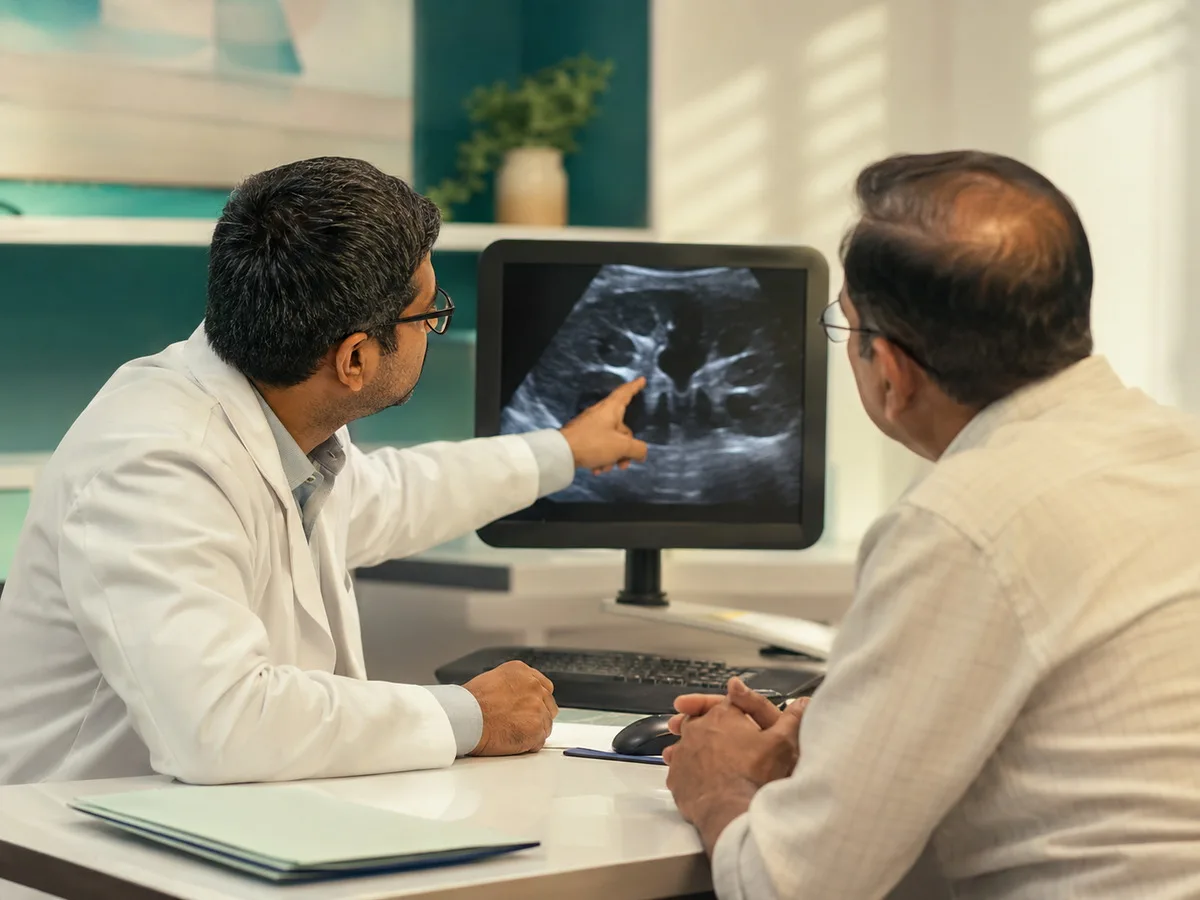
The scan report says there is a stone, and it gives a number in millimetres. Almost everyone asks the same question next: will it come out on its own, or does it need a procedure? Size is the single biggest clue, and this kidney stone size chart sets out what each range usually does. But size alone will not answer it, and the second half of this guide from our urology department in Sonipat explains what else decides.
First, the measurement itself
Reports usually give the stone's longest dimension in millimetres. Ten millimetres make one centimetre, so a kidney stone size chart in cm is simply the same numbers divided by ten. A 0.6 cm stone and a 6 mm stone are the same stone.
Two things worth knowing about the number. Ultrasound tends to estimate; a CT scan measures far more precisely, which is why treatment decisions for anything borderline are usually made on CT. And a stone is rarely a neat sphere. A 7 mm stone that is long and thin can behave better than a 6 mm one that is round and rough.
The kidney stone size chart
These are the general patterns urologists work with, for stones sitting in the ureter, the narrow tube from kidney to bladder.
Under 4 mm. The large majority pass on their own, usually within a few weeks. Treatment is fluids, pain relief and patience, with a medicine that relaxes the ureter to help it along.
4 to 6 mm. Roughly half pass on their own, and often it takes longer, sometimes several weeks. Many are managed with a watch-and-wait approach and medical help, with a clear plan for what happens if it does not move.
6 to 8 mm. The chance of passing drops sharply. Some still come out, but many need a procedure. This is the range where the decision depends most on everything else in this article.
Over 8 mm. Unlikely to pass. These usually need removing.
Over 10 mm, or 1 cm. Very unlikely to pass, and generally treated actively.
Over 20 mm, or 2 cm, inside the kidney. These are managed with a keyhole procedure through the back, because a stone this size cannot be cleared any other way.
For stones sitting inside the kidney rather than the ureter, the arithmetic is different. A small stone in the kidney may cause nothing at all for years and simply be watched. The size at which it needs treatment depends on whether it is growing, whether it is blocking anything, and where in the kidney it sits.
Why position matters as much as size
Two stones of identical kidney stone size in mm can behave completely differently depending on where they are.
The ureter has three natural narrow points. Where it leaves the kidney, where it crosses over the pelvic blood vessels, and where it enters the bladder. Stones stick at these points. A 5 mm stone already down at the bladder entrance has cleared the hard part and will very likely pass. The same stone at the top, just below the kidney, has a long way to go.
The good news within that: the further down a stone has travelled, the better its chances, which is why the position on your scan is genuinely encouraging information rather than just detail.
Other things that shift the odds include your own anatomy, whether you have passed stones before, and how much swelling has built up behind the stone.
What actually decides the treatment
Size and position set the starting point. These decide the rest.
Infection. A blocked kidney with infection behind it is an emergency, whatever the stone measures. Fever with stone pain means immediate drainage, not waiting. This is the one situation where size becomes irrelevant.
Kidney function. A blockage that is threatening the kidney is treated promptly, because a kidney under sustained back-pressure loses function. This matters enormously when someone has only one working kidney, or stones on both sides.
Pain that cannot be controlled. If pain keeps returning despite proper medication, waiting stops being reasonable.
Time. A stone that has not moved in four to six weeks is unlikely to move at all, and leaving it longer risks scarring the ureter.
Your circumstances. Someone about to travel to a place with no medical access, or in a job where sudden severe pain would be dangerous, may reasonably choose to have a passable stone removed rather than gamble.
Vomiting. Not being able to keep fluids or medicines down changes the plan on its own.
Helping a stone pass, and what to expect
If your stone is in the passable range and there is no infection or blockage, this is the plan.
Drink enough that your urine stays pale, which usually means two to three litres a day, and more in Haryana's summer. Take pain relief as prescribed, in a regular pattern rather than only when it becomes unbearable. Take the ureter-relaxing medicine if your urologist has prescribed one. Stay reasonably active, since lying still does not help.
Strain your urine through a fine sieve or cloth so the stone can be caught. That matters more than people realise. Analysing the stone tells us what kind it is, and that shapes your prevention plan. Otherwise it goes into a toilet bowl and takes the information with it.
Expect the pain to come in waves. Expect the last stretch, near the bladder, to bring an urgent, burning need to pass urine. Some blood in the urine is common as the stone scrapes its way down.
Go to an emergency department if fever or chills appear, if vomiting stops you keeping fluids down, if pain will not settle with your medicines, or if you are passing very little or no urine.
When it needs removing
Once a stone is not going to pass, the modern options are minimally invasive, and open surgery has essentially disappeared from routine stone care.
Ureteroscopy passes a thin scope up the urinary tract, breaks the stone with a laser and removes the fragments. RIRS reaches stones inside the kidney the same way. There is no external cut. PCNL, through a small keyhole in the back, handles the large kidney stones. Shockwave therapy breaks certain stones from outside the body.
Which one suits you depends on the stone's size, position, hardness and your anatomy. Our companion guide covers how kidney stones are treated in more detail.
The part people skip: once you have formed one stone, you are more likely to form another. Preventing stones in summer matters more in this climate than almost anywhere, because a hot Haryana summer concentrates urine faster than most people replace fluid.
Stone care at Memorial Hospital, Sonipat
Stones here are managed by Dr. Gaurav Singh Randhawa, MBBS, MS, M.Ch (Urology), a senior consultant in endo-urology with more than 10,000 minimally invasive procedures, including over 3,000 ureteroscopies and over 3,000 PCNLs. Urology OPD runs Monday to Saturday, 10:30 AM to 1:30 PM. Ultrasound, X-ray and laboratory testing are in-house, so a stone can be sized, located and assessed for infection or kidney strain in a single visit rather than across several. Where a stone is in the passable range, the plan is watchful with clear instructions on what should trigger a return. Severe stone pain, and any stone pain with fever, is seen through the 24×7 emergency. Kidney stones are unrelated to gallbladder stones, which form in a different organ for different reasons and are treated differently.
Frequently asked questions
Can a 6 mm kidney stone pass on its own?
Sometimes, but the odds fall steeply above 5 mm. A 6 mm stone already low down near the bladder has a fair chance with fluids, pain relief and a ureter-relaxing medicine. The same stone high up near the kidney is much less likely to pass, and many are treated actively rather than waited on.
How long does a kidney stone take to pass?
Small stones under 4 mm often pass within one to three weeks. Larger ones in the passable range can take four to six weeks. Beyond about six weeks with no movement, a stone is unlikely to pass and leaving it risks damage, so treatment is usually advised at that point.
What size kidney stone needs surgery?
As a general guide, stones above 8 to 10 mm usually need a procedure, and kidney stones above 2 cm are managed with keyhole surgery through the back. But size is not the only trigger. Infection, blockage, uncontrolled pain or falling kidney function can make even a small stone need urgent treatment.
Is a 3 mm kidney stone serious?
Usually not. Most stones this size pass on their own with plenty of fluids and pain relief. It still deserves a proper assessment, because even a small stone can block the ureter or become infected, and because catching the stone to have it analysed helps prevent the next one.
Get the number and the position
A stone's size tells you a lot, and where it sits tells you the rest. If a scan has found a stone, have it assessed properly rather than waiting to see what happens, particularly if pain keeps returning. Book a urology consultation with Dr. Randhawa, OPD Monday to Saturday, 10:30 AM to 1:30 PM. For stone pain with fever, or if you cannot pass urine, go to the emergency department straight away. This article is general information and not a substitute for a consultation. Some stones form from uric acid, which is covered in our guide to the uric acid normal range.
Medically reviewed by Dr. Gaurav Singh Randhawa, MBBS, MS, M.Ch (Urology), Memorial Hospital, Sonipat.
Related specialty: Urology
Editorial note: This article is for general information and is not a substitute for personal medical advice. Please consult a qualified doctor about your specific symptoms. Last updated on 26 September 2026.