



Somewhere after fifty, many men quietly plan their lives around their bladder. They map toilets on the highway. They cut the evening chai. They wake twice a night. Most never mention it to a doctor. They assume it is "just age". Usually the cause is a treatable one: an enlarged prostate. Know the prostate enlargement symptoms that matter, and the few that mean hurry. Then you can act early instead of adjusting forever. This guide from our urology department in Sonipat explains what the prostate is, why it grows, and what modern treatment looks like.
What the prostate does - and why it grows
The prostate is a small gland, normally the size of a walnut. It sits just below the bladder in men. It wraps around the urine passage (the urethra). Its job relates to reproduction. But its location is what causes trouble. As men age, the prostate slowly grows. Doctors call this benign prostatic hyperplasia, or BPH. As it grows, it squeezes the very tube urine must pass through.
BPH is very common. Roughly half of men in their fifties have some degree of it. The share keeps rising with age. Two things are worth saying clearly at the start. First, "benign" means exactly that. BPH is not cancer and does not turn into cancer. Second, common does not mean untreatable. No man needs to simply live with a miserable bladder.
Prostate enlargement symptoms to watch for
The classic prostate enlargement symptoms creep in slowly. That is why they are so easily brushed aside.
A weak or slow stream. The flow that used to be strong now takes effort to start. It dribbles at the end, or stops and starts midway.
Frequent urination. Men who once crossed the day in comfort now visit the toilet every hour or two. Frequent urination in men over fifty is one of the commonest reasons for a urology visit. BPH tops the list of causes.
Night-time waking (nocturia). Getting up once at night can be normal. Getting up two, three or four times, night after night, is not. Broken sleep is often the symptom that finally wears men down.
Urgency. A sudden, strong need to pass urine that is hard to hold. Sometimes there is leakage before you reach the toilet.
A feeling of incomplete emptying. You finish, and at once feel the bladder is not quite empty.
Straining or pushing to pass urine. Dribbling that stains clothing after you finish.
If several of these sound familiar, that pattern has a name, a cause and a treatment. It is not simply part of turning fifty-five.
Is it BPH - or something more serious?
BPH is by far the most common explanation. But a urologist's check exists to rule out the less common ones. These are prostate cancer, bladder stones, urine infection, and narrowing of the urine passage. Some symptoms need faster attention. Blood in the urine should always be checked promptly. So should burning with fever, or pain in the lower belly or back. Bladder stones, by the way, behave differently from kidney stones. We cover kidney stone treatment separately.
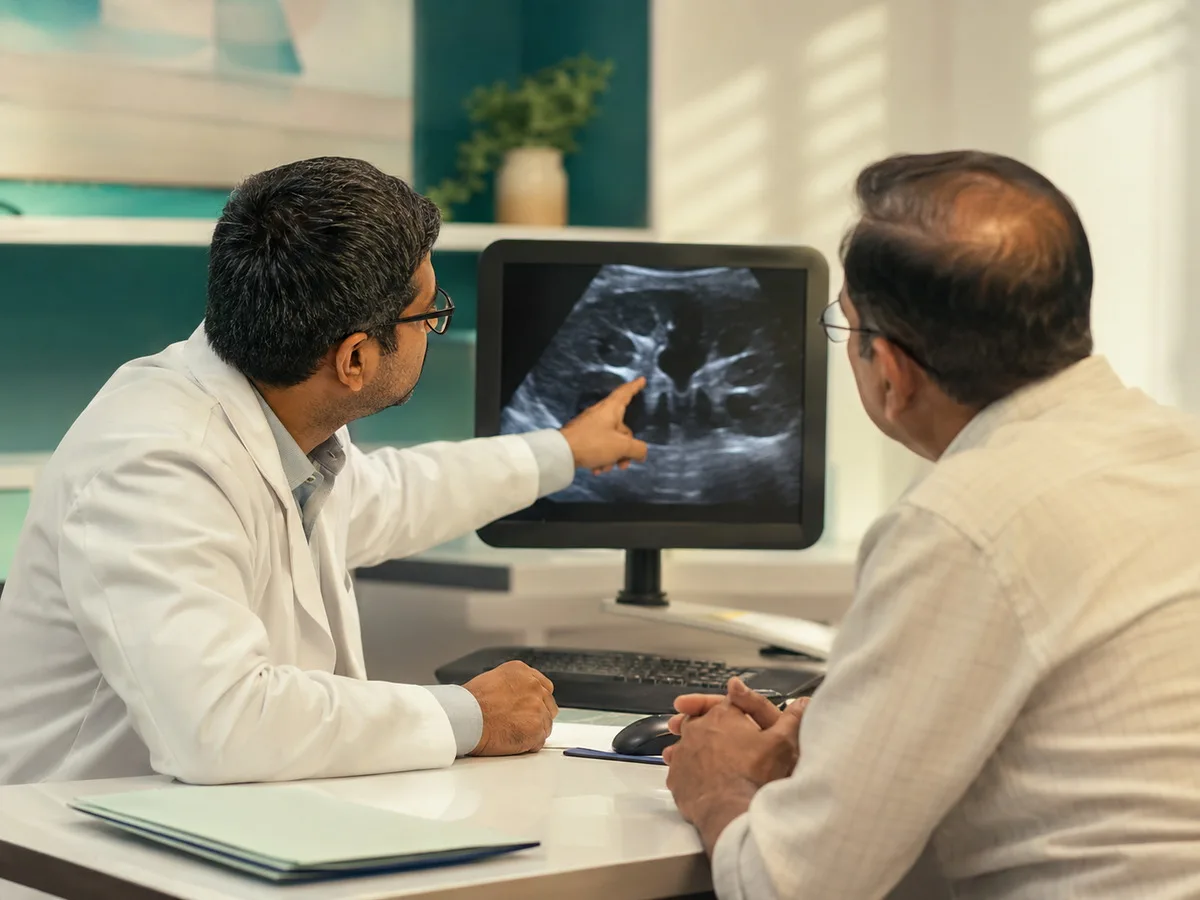
The check-up itself is simple. There is a symptom questionnaire and a urine test. An ultrasound shows prostate size, bladder emptying and the kidneys in one scan. A urine-flow test measures how well you pass urine. Where suitable, a PSA blood test is added, and we discuss it with you first. All of this is available in-house at Memorial Hospital, usually in a single visit.
When to see a doctor - and when it is urgent
See a urologist when urine symptoms begin to get in the way of life. That means broken sleep, planned journeys, avoided functions, or simply a bladder that dictates your schedule. Early review matters. A bladder that stays blocked for a long time slowly weakens. A weakened bladder recovers less fully, even after treatment.
One situation is a real emergency: acute urinary retention. This means suddenly being unable to pass urine at all, with a painfully full bladder. It needs immediate relief with a catheter. Memorial Hospital's emergency department handles it 24×7. Repeated urine infections, kidney swelling on ultrasound, or bladder stones also move treatment up the priority list.
BPH treatment: from lifestyle steps to TURP
BPH treatment is matched to how much the symptoms bother you. It also depends on whether complications have appeared.
Lifestyle steps help milder cases. Trim evening fluids. Go easy on tea, coffee and alcohol, as all of them irritate the bladder. Review any medicines that worsen retention. Keep timed bladder habits.
Medicines are the usual next step. One family of tablets relaxes the muscle around the prostate within days to weeks. Another slowly shrinks the gland itself over months. Many men do well on tablets for years.
Surgery is considered when tablets stop working. It is also needed when retention, stones, infections or kidney pressure appear. The most common operation is TURP (transurethral resection of the prostate). TURP is done through the urine passage itself, with no external cut. The inner part of the prostate that blocks the flow is removed. The hospital stay is usually short. TURP remains the standard operation worldwide. Our urologist has performed more than 1,000 TURP procedures.
Prostate care at Memorial Hospital, Sonipat
If you are looking for a prostate doctor in Sonipat, Memorial Hospital's urology OPD runs Monday to Saturday, 10:30 AM to 1:30 PM. It is led by Dr. Gaurav Singh Randhawa, MBBS, MS, M.Ch (Urology). He is a senior consultant urologist with more than 10,000 endo-urology procedures behind him. The full check-up - ultrasound, urine tests, flow studies, PSA - happens in-house. Treatment is stepped sensibly from lifestyle to tablets to surgery. Emergencies like retention are covered around the clock.
Frequently asked questions
Is prostate enlargement the same as prostate cancer?
No. BPH is a benign, non-cancerous growth of the prostate. It does not turn into cancer. The two can, however, cause similar urine symptoms. That is why a urologist's check, and sometimes a PSA blood test, is used to tell them apart with confidence.
Is frequent urination in men always due to the prostate?
No. Diabetes, urine infections, bladder stones, certain medicines and heart conditions can all make you pass urine more often. That said, in men over fifty with a weak stream and night-time waking, an enlarged prostate is the most common cause. A single OPD visit with ultrasound and urine tests usually settles the question.
Can BPH be managed without surgery?
Very often, yes. Lifestyle changes and modern tablets control symptoms well for many men, sometimes for years. Surgery such as TURP is kept for men whose symptoms persist despite medicines. It is also used when complications like retention, stones or repeated infections develop.
Which doctor should I see for prostate problems in Sonipat?
A urologist. At Memorial Hospital, Dr. Gaurav Singh Randhawa (MBBS, MS, M.Ch Urology) runs the urology OPD Monday to Saturday, 10:30 AM to 1:30 PM. Full in-house checks are available, and so are both medical and surgical BPH treatment.
Do not keep adjusting around it
If your bladder has started writing your daily schedule, it is time to push back. Book a urology OPD appointment - Monday to Saturday, 10:30 AM to 1:30 PM - and get a clear answer in one visit. This article is general information and not a substitute for a consultation.
Medically reviewed by Dr. Gaurav Singh Randhawa, MBBS, MS, M.Ch (Urology), Memorial Hospital, Sonipat.
Related specialty: Urology
Editorial note: This article is for general information and is not a substitute for personal medical advice. Please consult a qualified doctor about your specific symptoms. Last updated on 15 August 2026.