



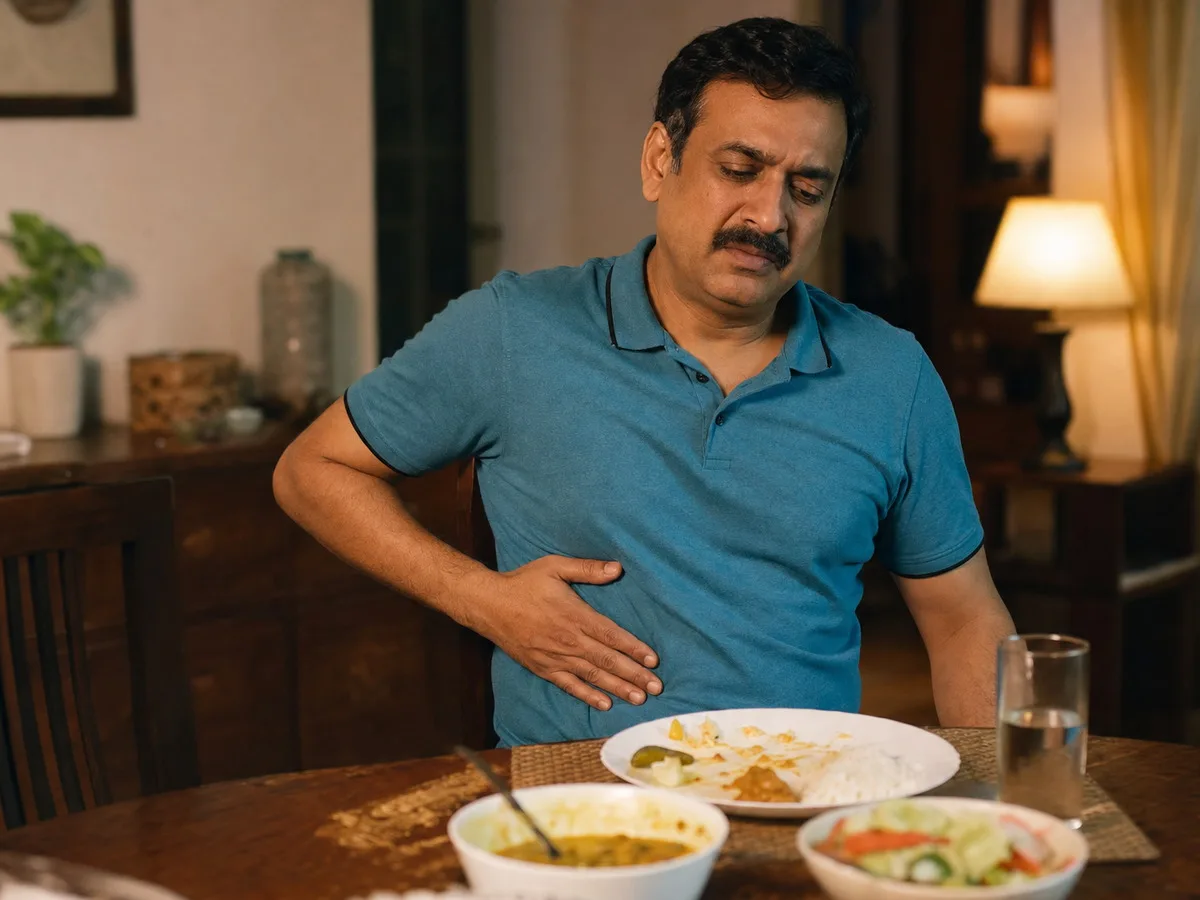
For years, it gets called acidity. Antacids are bought by the strip. The last dinner gets blamed. Then the pain comes back after the next rich meal, and the cycle repeats. Gallbladder stone symptoms are among the most commonly missed causes of upper abdominal pain in India, and the confusion is understandable, because the two really do feel alike at first. The difference matters for one reason: acidity is uncomfortable, and a blocked gallbladder can become an emergency. This guide from our laparoscopic surgery team in Sonipat explains how to tell them apart.
What the gallbladder does, and why stones form
The gallbladder is a small pouch tucked under the liver. It has one job. The liver makes bile, which helps digest fat, and the gallbladder stores it between meals. When a fatty meal arrives, the gallbladder squeezes and pushes bile into the intestine.
Stones form when the chemistry of that bile tips out of balance. Cholesterol or pigment then crystallises out. The crystals grow slowly, over years, into stones. Some people carry a single stone the size of a pea. Others have dozens of tiny ones, like gravel.
Most stones cause no trouble at all. They sit there quietly and are found by accident on an ultrasound done for something else. Trouble starts only when a stone moves and blocks the outlet.
Who gets them? The pattern is well known. It is commoner in women, especially after several pregnancies. Being overweight raises the risk. So does losing weight very fast. Diabetes, a family history and a diet high in fried and rich food all contribute. In north India this combination is common, which is why gallstones fill so many surgical lists here.
Where the pain actually is

This is the part that separates it from acidity.
Acidity burns. It sits behind the breastbone, rises upward toward the throat, tastes sour, and typically eases with an antacid. It is worse lying down and often worse at night.
Gallbladder pain grips. It sits in the upper right side of the abdomen, just under the rib cage. It is a deep, tight, building pain rather than a burn. Classically it starts thirty minutes to an hour after a fatty or fried meal. It builds over minutes. It holds steady for half an hour to a few hours. Then it fades. An antacid does very little.
Two more clues are worth knowing. Gallbladder pain often travels: through to the back between the shoulder blades, or up into the right shoulder tip. And it frequently comes with nausea or vomiting.
Our guide to acidity covers the other side of this comparison in detail. If antacids have been working for years and the pain genuinely burns, acidity is the likelier answer. If the pain grips under the right ribs after fried food and shrugs off antacids, the gallbladder deserves an ultrasound.
Gallbladder stone symptoms beyond the pain
Gallstones can announce themselves in less obvious ways.
Bloating and wind after fatty meals, with a full, heavy feeling that lasts hours. Many people quietly stop eating fried food and never mention it to a doctor.
Repeated indigestion that has been investigated as gastritis without much improvement.
Intolerance of specific foods such as parathas, puri, mutton or heavy sweets, while plain food is fine.
None of these are proof of anything on their own. But an ultrasound of the abdomen settles the question in about ten minutes, and it is quick, painless and uses no radiation.
The signs that turn it into an emergency
Most gallstone attacks settle on their own. These do not, and they need same-day medical attention.
Pain that does not stop. An attack lasting beyond five or six hours suggests the stone is stuck rather than passing.
Fever and chills with the pain. That points to infection in a blocked gallbladder, which can progress quickly.
Yellow eyes or skin, dark urine, pale stools. This means a stone has moved out of the gallbladder and is blocking the main bile duct. Our guide to jaundice explains what that yellowing means and why it is never something to watch and wait on.
Severe pain spreading to the back with repeated vomiting. A stone can block the pancreatic duct and trigger pancreatitis, which is a serious illness needing admission.
Any of these four means the emergency department, not the morning OPD.
When the gallbladder has to come out

Here is the honest answer, and it differs from kidney stones in an important way.
Stones found by accident, in someone who has never had symptoms, can often simply be watched. No medicine dissolves them reliably, but many people carry them for life without a problem.
Once stones have caused a real attack, the picture changes. Attacks tend to come back. Each one carries a risk of the problems above. So for symptomatic gallstones, removal is usually advised, and the operation removes the gallbladder itself rather than just the stones. That surprises people. But it is the point. Leave the pouch behind and it simply makes new stones.
Gallbladder removal surgery is done by keyhole. The operation uses three or four small cuts, a camera and fine instruments. Most patients are walking the same evening, home within a day or two, and back to desk work inside a week or two. Compared with the old open operation and its long scar, it is a different experience entirely.
Life afterwards is normal. The liver keeps making bile, which now drips steadily into the intestine instead of being stored. Most people eat normally within weeks. A minority find very heavy, oily meals loosen the bowels for a while, and that usually settles.
This is a good moment to clear up a common mix-up. Gallstones and kidney stones are unrelated. Different organ, different cause, different treatment. Having one does not mean you will get the other.
Gallbladder surgery at Memorial Hospital, Sonipat
Laparoscopic surgery here is led by Dr. Gaurav Singh Randhawa, MBBS, MS, M.Ch, who has performed more than 10,000 minimally invasive procedures. OPD runs Monday to Saturday, 10:30 AM to 1:30 PM. In-house ultrasound and laboratory mean the diagnosis is usually settled in a single visit rather than across several. Keyhole gallbladder removal is routine work here, with ICU backup for the small number of cases that arrive already infected or jaundiced, and the 24×7 emergency department takes the attacks that come in at night. The hospital has run surgical services in Sonipat for five decades, so the local pattern of this disease is familiar ground.
Frequently asked questions
How do I know if it is gallstones or just acidity?
Acidity burns behind the breastbone, rises toward the throat and eases with an antacid. Gallbladder pain grips under the right ribs, starts within an hour of fatty food, can spread to the back or right shoulder, and antacids barely touch it. An abdominal ultrasound settles it quickly, so there is no need to keep guessing.
Can gallstones be dissolved with medicine?
Not reliably. Some medicines can slowly dissolve certain small cholesterol stones, but treatment takes many months, works in few people, and stones usually return once it stops. For stones that have caused symptoms, keyhole removal remains the dependable answer.
Is gallbladder removal surgery safe?
Laparoscopic cholecystectomy is one of the commonest and best-established operations in the world. It uses three or four small cuts, most patients go home within a day or two, and serious complications are uncommon. Risk rises when surgery is delayed until the gallbladder is badly infected, which is an argument for treating attacks sooner rather than later.
Can I live normally without a gallbladder?
Yes. The gallbladder stores bile but does not make it. After removal the liver simply delivers bile straight to the intestine. Most people eat a normal diet within a few weeks. Some find very oily meals upset the bowels for a while, and that generally settles with time.
Get the ultrasound, stop guessing
If pain under the right ribs keeps returning after rich meals, and antacids have never really fixed it, an ultrasound will answer the question in one visit. Book a surgical consultation with Dr. Randhawa, OPD Monday to Saturday, 10:30 AM to 1:30 PM. For pain lasting more than a few hours, or any fever or yellowing of the eyes, use the 24×7 emergency department instead of waiting. This article is general information and not a substitute for a consultation. Pain low on the right rather than under the ribs points somewhere else entirely: see our guide to the appendix operation.
Medically reviewed by Dr. Gaurav Singh Randhawa, MBBS, MS, M.Ch (Urology), Memorial Hospital, Sonipat.
Related specialty: General & Laparoscopic Surgery
Editorial note: This article is for general information and is not a substitute for personal medical advice. Please consult a qualified doctor about your specific symptoms. Last updated on 9 September 2026.