



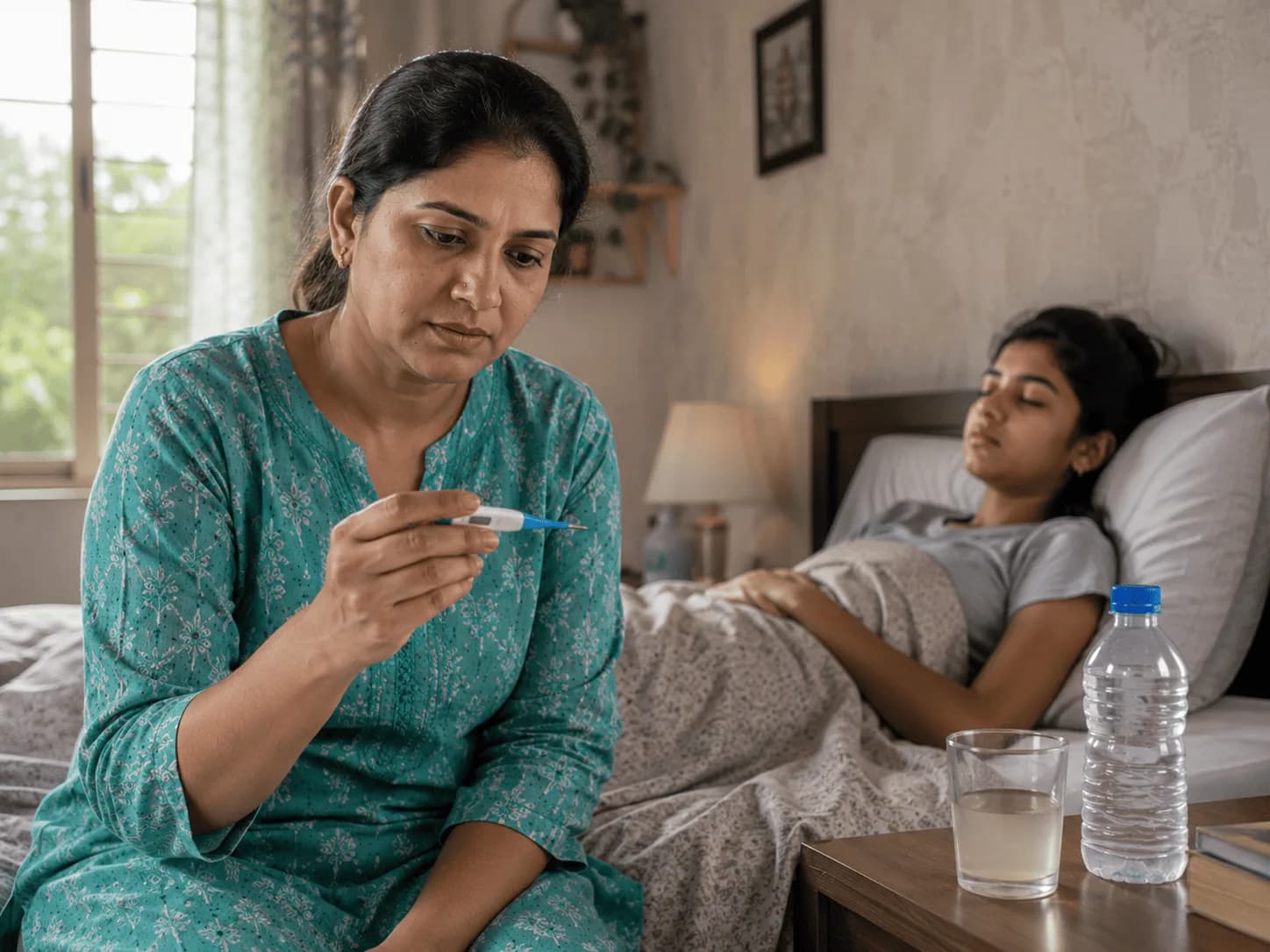
Here is dengue's most dangerous secret. The crisis usually begins when the fever ends. Families relax on day four as the temperature falls. That is exactly when the illness picks its path. Over the next 24 to 48 hours it either fades away quietly or turns severe. Knowing the dengue warning signs by heart is what keeps a managed illness from becoming a midnight emergency. This guide comes from our physician and critical-care team in Sonipat. It walks you through the timeline, the signs that mean hospital now, and what platelet counts really tell you. And not every monsoon fever is dengue - three of them look alike in the first days.
How dengue behaves: the three phases
Dengue starts two to seven days after the bite of an infected mosquito. This mosquito bites by day, not by night.
The first phase is the fever phase. It brings high fever and a crushing headache. Pain sits deep behind the eyes. Muscles and joints ache so badly that dengue earned the name "breakbone fever". Nausea and a flushed face are common too. It feels awful. It is rarely dangerous on its own.
The second phase is the critical phase, and this is dengue's trick. Around day three to five the fever settles. At the same time, the liquid part of the blood can start leaking out of the vessels. Platelet counts drop as well. Most patients cross these 24 to 48 hours with no trouble at all. The few who turn severe show it here, through the warning signs below. That is why day four to six is watching time, not celebration time.
The third phase is recovery. The leaked fluid returns to the blood. Counts climb. Appetite comes back. An itchy, blotchy rash often marks the turn. Deep tiredness can linger for a week or two. Respect that tiredness. Going back to full work and exercise too soon stretches recovery out rather than cutting it short.
The dengue warning signs: learn these by heart
During the fever's fall, or just after it, any one of these signs means hospital now. Not one more day of watching at home.
Severe belly pain that will not let up, especially on the right side under the ribs. Vomiting again and again, or not being able to keep any fluid down. Any bleeding counts here: gums, nose, blood in vomit or stool, black tarry stool, heavy periods, or a shower of tiny red spots on the skin. Extreme tiredness, drowsiness, confusion or restlessness are red flags too, because they show the brain is not getting enough blood. Cold, clammy hands and feet, giddiness on standing, or a fast and weak pulse mean much the same thing. Breathlessness or a tight chest belongs on this list as well.
Two groups need an even lower threshold. Infants and pregnant women, in any trimester, should be reviewed in hospital from the start.
None of this waits for morning. Memorial Hospital's 24×7 emergency exists for the 2 AM version of this decision.
What home care looks like - when home is safe
Plain dengue really is safe to treat at home. That means the test is positive and there are no warning signs. Push fluids hard: water, ORS, coconut water and soups. Aim for pale urine, and check it through the day. Use paracetamol only, and only for fever. Rest fully, even when you feel a little better. Get a daily medical review, with blood counts as advised.
Two rules are hard rules. No aspirin and no ibuprofen-type painkillers, because they make dengue bleeding worse. And no antibiotics, because they do nothing against a virus.
A mosquito net over the patient protects the rest of the family. The same monsoon prevention checklist that keeps dengue out of the house also keeps it from spreading inside.
Is it dengue - or another monsoon fever?
The monsoon runs several fevers at once, and each one is treated differently. Dengue's signature is a sudden high fever with eye-socket pain and body aches. Typhoid builds up slowly, with a step-ladder fever, belly discomfort and marked weakness. Malaria classically cycles with chills and drenching sweats. Ordinary viral fevers sweep through a whole house in a few days.
Guesswork fails here. A fever panel sorts it out in one visit. It runs dengue tests, typhoid tests, a malaria smear and a blood count, all in-house. Getting the name right on day two or three changes everything that follows. Dengue gets the right watching. Typhoid gets the right antibiotics. Malaria gets the right medicines. And a viral fever gets no wasted antibiotics at all.
The platelet question, answered honestly
Every dengue season, forwarded messages give platelets the starring role. So let us set the record straight. The dengue platelet count matters, but far less than families think.
Counts often fall to scary-sounding numbers and then recover with no transfusion at all. Doctors watch the trend, not a single reading. They read it next to another value called the haematocrit, which shows whether plasma is leaking. Platelet transfusion is kept for a few clear situations, such as real bleeding or a very low count. It is not given for every falling number. What the number itself means, and the level at which it actually changes treatment, is set out in our guide to the platelet count normal range.
No juice reliably raises platelets. Papaya leaf, kiwi and goat milk have testimonials, not evidence. Fluids, close watching and timely hospital care are what carry patients through. Counts climb back on their own as the illness clears.
Dengue treatment at Memorial Hospital, Sonipat
There is no antiviral pill for dengue. Done right, dengue treatment in Sonipat is expert supportive care with perfect timing.
It starts with confirming the diagnosis. Our in-house laboratory runs NS1 and antibody tests, then serial blood counts. Stable patients are watched through the OPD. Patients with warning signs are admitted, and carefully measured IV fluids do the real life-saving work.
Care is led by Dr. Sameer Mehta, MBBS, MD, physician and critical-care specialist (OPD daily 11 AM to 2 PM, plus 6 to 7 PM Monday to Saturday). ICU and ventilator support back the sickest cases. The 24×7 emergency takes the night-time decisions.
Severe dengue caught at the warning-sign stage is very survivable. Caught at the shock stage, it is a hard fight. The difference is the watchfulness this article teaches.
Frequently asked questions
When should a dengue patient be taken to hospital?
The moment any warning sign appears. That means severe belly pain, repeated vomiting, any bleeding, unusual drowsiness or restlessness, cold hands and feet, giddiness, or breathlessness. Watch hardest on days three to six, when the fever falls. Infants, pregnant women and people with long-term illness deserve hospital review from the start.
Why is the danger period after the fever drops?
The falling fever marks the start of dengue's critical phase. For the next 24 to 48 hours, plasma can leak out of the blood vessels. Most patients pass through this safely, and the few who turn severe show it here. Watching closely on days four to six saves lives, more than fretting over day one's high fever.
At what platelet count is admission needed in dengue?
There is no single magic number. Doctors weigh the trend, the haematocrit, any bleeding and the warning signs together. Many patients with low-sounding counts recover well and need no transfusion. A "decent" count with severe belly pain still means admission. Trust the clinical picture over thresholds from forwarded messages.
Where can I get dengue treatment in Sonipat?
Memorial Hospital runs dengue testing and serial counts in-house. OPD monitoring is with Dr. Sameer Mehta (daily 11 AM to 2 PM, plus 6 to 7 PM Monday to Saturday). The 24×7 emergency handles admission, IV fluid management and ICU backup for warning-sign and severe cases.
Watch the right days, not just the thermometer
Mark the calendar on the day the fever starts. Watch hardest when it falls. Act on the first warning sign, not the third. Keep one sheet of paper with the patient's daily fluid intake, urine colour and any new symptom. It makes every medical review faster and sharper. For a fever review and counts, book an OPD review. For any warning sign, come straight to the 24×7 emergency. This article is general information and not a substitute for seeing your own doctor.
Medically reviewed by Dr. Sameer Mehta, MBBS, MD (General Medicine & Critical Care), Memorial Hospital, Sonipat.
Related specialty: General Medicine
Editorial note: This article is for general information and is not a substitute for personal medical advice. Please consult a qualified doctor about your specific symptoms. Last updated on 26 September 2026.