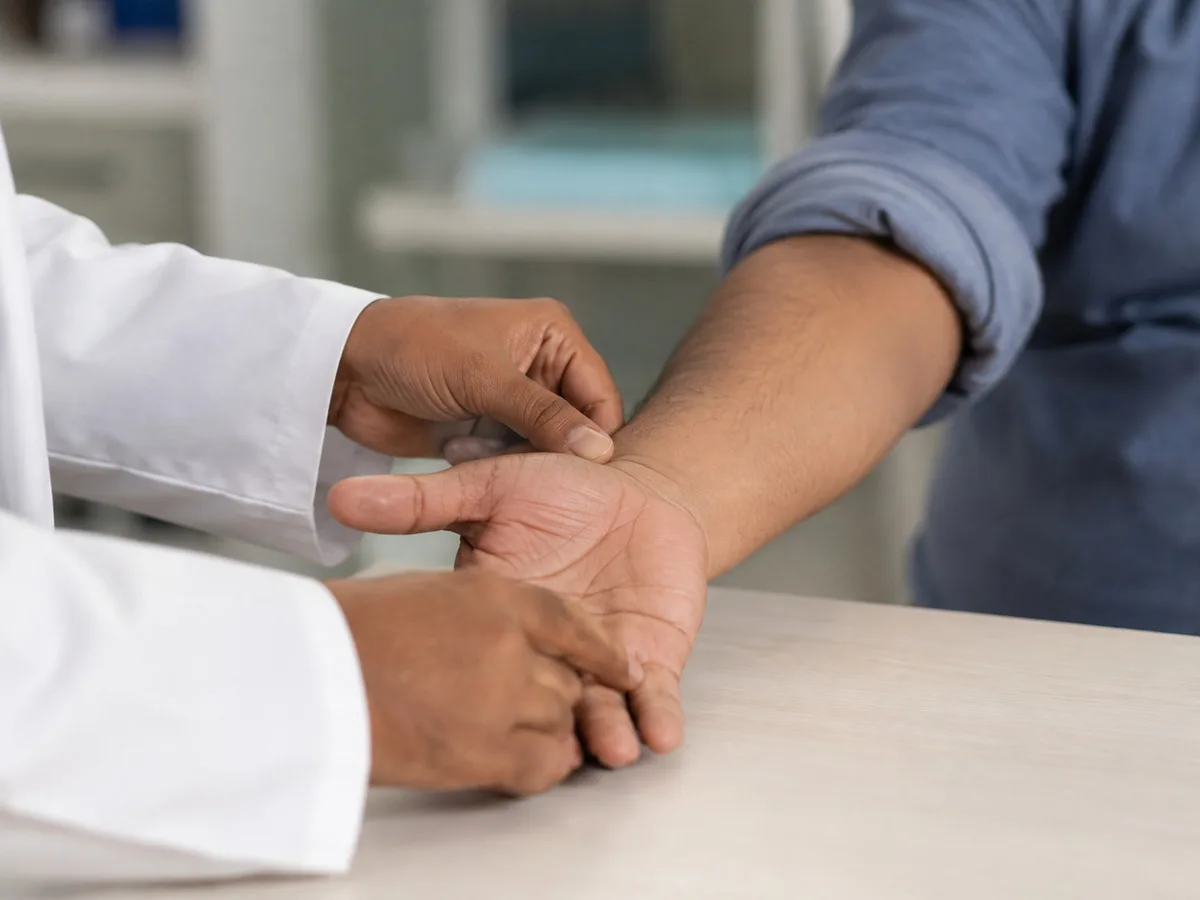




Parkinson's disease almost never arrives with a bang. It comes in small pieces, and families only join them up later. Papa's right hand shakes as it rests on the armchair. His writing has shrunk to half its old size. He walks slower, his voice has gone soft, he smiles less. Each piece on its own looks like plain old age. That is exactly why Parkinson's early signs get missed for months, or even years. This guide comes from our neurology and brain care team in Sonipat. It sets out what to watch for, which tremors are not Parkinson's at all, and why acting early really does change the road ahead.
What Parkinson's disease actually is
Deep in the brain sits a small group of cells that make dopamine, the chemical that keeps movement smooth and easy. In Parkinson's disease these cells fade away slowly, and movement loses its polish. It turns smaller, slower and stiffer.
The disease usually shows up after 60. But about one in ten patients notice symptoms in their forties or fifties. It moves ahead over years, not weeks. That slow pace is just what makes the start so easy to brush aside as "just age".
Two reassuring facts belong right at the top. First, this is not a death sentence. Most patients live long lives, and treatment keeps many of them working, walking and travelling for years. Second, shaking alone does not mean Parkinson's. Most tremors seen in any OPD have other causes, and far less serious ones.
Parkinson's early signs: what families notice first
The tremor at rest is the classic sign, and its character matters more than its presence. This tremor usually starts on one side - one hand, sometimes one foot. It appears when the limb is relaxed and doing nothing, resting on the lap or hanging while you walk. Patients often describe a "pill-rolling" motion between thumb and fingers. Tellingly, it eases or stops the moment the hand does real work, like lifting a cup.
Slowness is the sign doctors weigh most, and its medical name is bradykinesia. Families sense it long before they can name it. Everything takes longer: buttoning a shirt, turning in bed, rising from a chair, walking to the gate. Steps shorten into a shuffle, and one arm stops swinging while walking.
Then come the quiet signs, and very few of them make anyone think of the brain. Handwriting shrinks down a page, and doctors call this micrographia. An old signature and a new one look like two different people wrote them. The voice turns soft and flat, so the family keeps asking "what?" and blames their own ears. The face loses its natural play of feeling, and this "masked face" gets read as sadness, anger or a lack of interest. The sense of smell fades years before anything else, and constipation turns stubborn.
Sleep can change in a striking way, with some people acting out their dreams by shouting, punching or kicking while asleep. This can be one of the earliest signals the brain sends, sometimes a decade ahead. A stiff arm or shoulder may get treated as "frozen shoulder" for months, and a stooped posture creeps in. Put all of this together and the picture is complete, long before anyone says the word Parkinson's.
No single sign settles the question. But slowness with a resting tremor is a telling pair, and so is a cluster of these quiet changes in one person. Either one deserves a neurologist's opinion, not another year of watching and hoping.
Not every tremor is Parkinson's
This point spares families months of silent fear. The commonest tremor in any clinic is essential tremor, and it behaves the other way round. It appears during action - holding a full cup, signing a form, eating dal with a spoon. It affects both hands, often runs in families, and may even settle a little after rest. It is a nuisance, but it is harmless, and it is managed in a wholly different way.
Other causes are common too. An overactive thyroid, low blood sugar, anxiety and alcohol withdrawal all cause shaking. So do several everyday medicines, including some stomach, nausea and psychiatric drugs. Good tremor treatment in Sonipat, or anywhere else, therefore starts with the right label, not with a medicine for shaking. A drug-induced tremor goes away when the prescription changes. A thyroid tremor goes away when the thyroid is treated.
When to book a neurologist consultation
Here is a sensible rule. Book when a tremor appears at rest, or when slowness or stiffness changes daily activities. Book too when several of the quiet signs above have gathered in one person, especially past fifty.
Come sooner, and through emergency rather than an OPD, if symptoms appear suddenly over hours or days. Parkinson's never starts that fast. Sudden weakness on one side, slurred speech or a drooping face belongs to stroke warning signs. That is a different and urgent story. Unsteadiness with a spinning feeling usually points to dizziness and balance problems instead. That is one more reason a proper check beats guessing.
The diagnosis itself is clinical, and there is no blood test for Parkinson's. A neurologist makes the call by examining muscle tone, speed of movement, walking and the nature of the tremor. Brain imaging is sometimes added to rule out look-alikes, such as small strokes or hydrocephalus. This is just the kind of check where a trained DM neurologist changes the outcome. Missed Parkinson's and wrongly labelled Parkinson's both take a heavy toll on the years that follow.
Why early diagnosis changes the road
The reason is simple: treatment works, and it works best when the road is planned early. Levodopa and related medicines replace the missing dopamine signal. In the early and middle years they can restore movement remarkably well. Doses and timing are tuned over follow-up visits like a raga, not written once and forgotten.
Exercise matters just as much, and here it is real medicine. Brisk daily walking, stretching, balance work and voice practice all slow the loss of function in ways you can measure. Physiotherapy keeps walking safe. Care for constipation, sleep, mood and blood pressure keeps the whole person well, not just the tremor.
Families have their own part to play. Make the home fall-proof with good lighting, railings and clear floors. And hold on to one truth: the soft voice and the still face are the disease talking, not a lack of feeling.
Parkinson's evaluation at Memorial Hospital, Sonipat
Worries about Parkinson's early signs can start in the daily physician OPD at Memorial Hospital. The examination and baseline tests happen in one visit, and in-house CT imaging is available when the picture demands it. Neurological cases are supported by Dr. VP Hooda, MBBS, MD, DM (Neurology), a DM-qualified neurologist who consults for admitted and referred patients. Please call the hospital to check his consultation availability.
Three things make that first visit count. Bring a short video of the tremor filmed at home, and bring the full list of current medicines. Bring one family member too, someone who has watched the changes. Together they answer half the questions before the examination even begins.
Frequently asked questions
What are the earliest signs of Parkinson's disease?
The earliest signs come as a cluster. Watch for a tremor in one hand at rest, slowness in daily tasks, and shrinking handwriting. The voice softens, the face shows less feeling, smell fades, constipation turns stubborn, and sleep gets noisy with acted-out dreams. One sign alone proves nothing, but several in the same person deserve a neurologist's check.
Is every hand tremor Parkinson's?
No, and most are not. Essential tremor, the commonest kind, appears during action rather than at rest, and it is harmless. Thyroid trouble, anxiety, low sugar and several common medicines also cause shaking. A neurologist can sort these out in one examination, so get checked before you worry.
At what age does Parkinson's start?
Most often after 60. But about one in ten patients get symptoms in their forties or fifties. Age alone should not decide whether you get checked; the pattern of symptoms should.
Can Parkinson's disease be cured?
There is no cure yet. Even so, it is among the most treatable long-term brain conditions. Dopamine-replacing medicines, planned exercise and physiotherapy keep most patients independent for many years. That holds best when treatment starts early and follow-up stays regular.
Name it early, manage it well
The cruellest version of Parkinson's is the one brushed off as old age for five years. If the pieces in this article sound like someone at home, book a consultation at Memorial Hospital. You can also call to check Dr. Hooda's availability. One unhurried check can replace a year of wondering. This article is general information, and it is not a substitute for a consultation.
Medically reviewed by Dr. VP Hooda, MBBS, MD, DM (Neurology), Memorial Hospital, Sonipat.
Related specialty: Neurology
Editorial note: This article is for general information and is not a substitute for personal medical advice. Please consult a qualified doctor about your specific symptoms. Last updated on 28 August 2026.